
Views: 0 Author: Site Editor Publish Time: 2026-08-03 Origin: Site


Frame weight represents much more than a physical specification on a simple data sheet. It heavily dictates freight logistics and transportation planning. It directly influences onsite handling efficiency for your crew. It determines structural safety limits during complex builds. You cannot ignore this critical metric during the procurement process. Miscalculating component mass leads to blown shipping budgets quickly. It also introduces potential safety compliance risks immediately. Site managers must calculate maximum intended loads accurately to protect workers.
We will break down standard weights across various popular frame types. We will explore material specifications in technical detail. You will learn how to evaluate manufacturer weight charts effectively. This knowledge protects your budget before you issue a formal purchase order. Accurate data prevents costly project delays. It ensures total structural integrity across the job site. Let us explore the numbers.
A standard 5’ x 5’ steel frame typically weighs between 35 and 45 lbs, depending on the wall thickness and design.
Weight directly correlates with maximum load capacity and the 4:1 safety factor required by safety regulations.
Logistics planning must account for the entire assembly, including braces and pins, not just the isolated frame.
Accurate weight data is critical for comparing vendor freight quotes (LTL vs. FTL) and calculating worker handling limits.
Establishing a solid baseline requires standardizing your dimensions first. Comparing a 5'W x 5'T unit against a 5'W x 6'4"T unit creates mathematical confusion. You need consistent measurements for accurate weight comparisons. Different job requirements demand different architectural designs. You must classify each component accurately. We will look at a standard 5x5 footprint for baseline comparisons. This provides a clear frame of reference.
Mason frames handle exceptionally heavy material loads. Bricklayers require massive support for concrete blocks and wet mortar. These frames feature thicker steel tubing universally. They lack a walk-through portal entirely. This design increases the total linear footage of steel used. Expect weights in the 40–48 lbs range for standard sizes. The horizontal bars sit much lower. This structural choice supports heavy staging planks easily.
Ideal for block walls and heavy masonry work.
Supports heavy wet mortar tubs safely.
Features thicker walls to prevent load buckling.
Walk-thru frames facilitate rapid personnel movement. We categorize these as S-Style or V-Style configurations. Workers pass through them easily along long building facades. They lack lower horizontal bars completely. This structural choice shifts the weight distribution upward significantly. Manufacturers compensate by thickening the arched upper supports. A typical walk-thru unit weighs between 38 and 45 lbs. The specific arch design dictates the final mass.
Ideal for long exterior commercial facades.
Allows continuous pedestrian traffic flow.
Requires robust upper arch designs for stability.
Ladder frames support easy climbing and frequent vertical tiering. Closer rung spacing provides built-in vertical access. This offsets their slightly narrower vertical profiles. A standard 5'x5' Steel Ladder Frame usually weighs between 35 and 40 lbs. They remain highly popular for painting applications. Stucco crews also favor them for their lighter maneuverability.
Ideal for tight spaces and narrow corridors.
Perfect for painting and light duty maintenance.
Eliminates the need for separate climbing ladders.
Frame Type (5' x 5' Standard) | Typical Weight Range (lbs) | Primary Application | Structural Characteristic |
|---|---|---|---|
Mason Frame | 40 - 48 lbs | Heavy bricklaying, masonry | Lower horizontal support bars |
Walk-Thru (S/V-Style) | 38 - 45 lbs | Personnel movement, facades | Open portal, thickened top arch |
Ladder Frame | 35 - 40 lbs | Painting, stucco, light duty | Close rung spacing, narrow profile |
Best Practice: Always confirm the exact dimensions before comparing weights. A 5x6'4" frame naturally weighs more than a 5x5 model.
Common Mistake: Mixing different frame styles in a single bay calculation. This skews your total dead load metric dangerously.
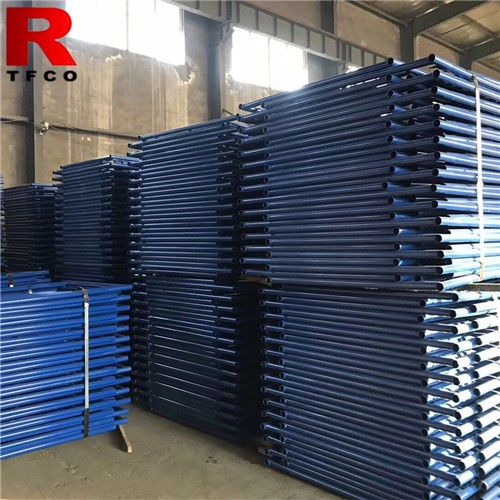
Tube Outside Diameter (O.D.) and wall thickness drive the total mass directly. The outside diameter heavily influences the physical footprint. You might compare a 1.625" O.D. tube against a 1.69" O.D. alternative. This minor fraction increases steel volume significantly over the frame's height. Wall thickness changes the equation completely. Moving from standard 13-gauge to heavy-duty 11-gauge steel adds substantial poundage. Thicker walls resist denting better on rough construction sites. They endure forklift impacts much more successfully.
Material surface treatments add marginal yet cumulative mass. Bare steel weighs the least but rusts extremely fast. Hot-dip galvanization immerses the steel directly into molten zinc. This zinc bonds metallurgically to both interior and exterior walls. It increases the overall mass noticeably per unit. A standard Painted Scaffold Frame holds protective powder coating or liquid paint. These finishes add fewer pounds than heavy galvanization. They still increase bulk across large full truckload shipments.
Manufacturing tolerances introduce natural variations constantly. Component mass varies up to 5% across different production runs. Steel mill batches change slightly in raw density. Welders deposit different amounts of filler metal at the joints. Reliable B2B vendors publish transparent tolerance ranges openly. They do not hide behind vague approximations. You should demand clear spec sheets immediately before purchasing.
A heavier frame does not inherently guarantee greater safety. We must debunk this dangerous industry assumption. You must evaluate the specific steel grade alongside pure mass. High-tensile strength steel weighs less but offers superior load-bearing capacity. Standard mild steel requires thicker walls just to match this strength. Pure mass cannot replace advanced metallurgical engineering. Lighter, stronger steel improves worker efficiency immensely.
OSHA mandates strict safety margins for elevated work environments. The bare weight forms your foundation's total dead load. You must calculate this metric precisely under OSHA 1926 Subpart L guidelines. The equipment must support its own weight plus four times the maximum intended load. This 4:1 safety factor protects workers from catastrophic failure. Heavy frames increase the dead load pressing on the base plates. They put more stress on the underlying soil or concrete pads.
Purchasers must verify strength through certified documentation. Never rely solely on physical weight as a strength proxy. A heavy product might utilize cheap, low-grade recycled steel. You must demand certified engineering test reports. These documents detail the exact safety factor calculations. They prove regulatory compliance definitively. They protect your workers from dangerous structural assumptions. We highly recommend reviewing test protocols carefully.
A single frame remains useless in isolation. You must estimate the true logistical mass per scaffolding bay. The overall system assembly creates a much higher total mass. Let us break down the essential components. Designing a complete structural network requires meticulous math. You must account for every single piece of hardware.
Cross braces stabilize the entire bay structure horizontally. You should add 10–15 lbs per pair of galvanized cross braces. Guardrail assemblies add similar amounts to the top tiers. You cannot ignore coupling components and foundation hardware. Base plates and screw jacks add concentrated weight at the very bottom. Every single Scaffold Joint Pin impacts the calculation. Each pin adds roughly 0.5 to 1 lb. A massive tower requires hundreds of pins.
Walking planks and decking represent the heaviest overall additions. Solid wood planks weigh heavily on the setup. Aluminum-plywood decks offer a lighter, more ergonomic alternative. You must calculate this combined dead load accurately. It dictates shipping requirements and foundation preparation methods. Soil compaction limits depend on this exact number.
You must account for these common accessories in your total bay mass:
Base plates: Add 2-4 lbs each.
Leveling screw jacks: Add 10-12 lbs each.
Aluminum walk boards: Add 30-40 lbs per 7-foot section.
Wooden toe boards: Add 5-10 lbs per section.
We recommend calculating total bay weight through these ordered steps:
Identify the bare weight of two vertical frames.
Add the combined mass of the required cross braces.
Include all connection hardware and stacking pins.
Factor in the decking platforms for the working level.
Sum the total to establish your precise foundation dead load.
Cumulative weight directly alters your shipping classifications. Transporting a few replacement components qualifies as Less-Than-Truckload (LTL). Large commercial orders push you quickly into Full Truckload (FTL) territory. Accurate data optimizes your freight budget effectively. You must know the exact weight of your chosen Scaffolding Frame model. FTL limits normally max out around 44,000 lbs in standard dry vans. Exceeding this limit triggers severe DOT fines.
Worker ergonomics matter immensely during site staging. You must factor in daily job site fatigue carefully. If a 6'6" tall unit weighs over 50 lbs, labor dynamics change completely. Workers move slower as the day progresses. Rotational lifting becomes absolutely necessary. Assembly requires more physical effort per hour. You must calculate these handling limits carefully to maintain productivity. Heavy materials increase injury rates statistically.
Watch for major red flags when shortlisting vendors. Missing weight specifications should stop a negotiation immediately. Unusually light frames indicate substandard thin-wall tubing definitively. Quality vendors offer distinct physical specs. Standard and premium product lines must demonstrate clear material differences. You should compare weight charts side-by-side.
Summarize the evaluation process strictly to protect your projects. You must verify dimensions before ordering anything. Check the steel gauge carefully. Calculate the entire system's dead load thoroughly. Finally, request a detailed freight quote from your supplier. Do not leave these logistics steps to chance. We encourage project managers to download our detailed spec sheets. Contact the sales team for an exact freight calculation today. They can match weights to your specific footprint perfectly.
A: A standard 5x5 frame typically weighs between 35 and 45 lbs. The exact number depends heavily on the steel gauge. Tube diameter and specific architectural style also play major roles. Mason frames weigh more. Ladder frames weigh less.
A: Yes. Paint and hot-dip galvanization add marginal weight to individual pieces. However, this bulk accumulates rapidly during bulk shipping. Zinc coatings bond metallurgically inside and out. You must account for surface finish weights when calculating full truckloads.
A: No. Sheer mass does not guarantee structural integrity. High-tensile steel provides exceptional strength at a much lighter weight. Low-grade recycled steel requires more mass to achieve basic strength. Always review certified engineering test reports instead of relying on pure weight.
A: You must sum all system components together. Add the exact weight of two frames. Include two cross braces. Factor in four joint pins. Add the walking platforms and base plates. This formula provides the exact shipping mass and foundation dead load.
