
Views: 0 Author: Site Editor Publish Time: 2026-08-06 Origin: Site


Choosing the correct scaffolding infrastructure represents a massive capital decision for construction firms. You need equipment capable of balancing labor costs, site safety, and overall project timelines. Poor choices easily drain budgets through excessive labor hours, structural limitations, or safety compliance delays. Procurement and project managers often face a common dilemma. They constantly weigh the low initial cost of a traditional frame setup against the premium adaptability of modular Ringlock platforms. This decision heavily shapes daily site operations.
We want to clear up this industry confusion. Our goal is to provide an evidence-based, side-by-side evaluation of both structural systems. You will learn exactly how to align equipment purchases with specific project geometries, load requirements, and target margins. We will thoroughly compare load mechanics, labor efficiency, and material durability. By the end, contractors can confidently specify the right gear for their upcoming bids.
Best for Linear Simplicity: A standard frame scaffold system remains the most cost-effective choice for straight facades, standard masonry, and low-complexity maintenance.
Best for Complex Geometries: Ringlock systems dominate industrial applications, circular structures, and projects requiring high load-bearing bypasses.
Cost vs. Labor Arbitrage: Ringlock requires a higher initial investment but significantly reduces erection and dismantling labor hours.
Component Synergies: Both systems rely on compliant decking (like a GI scaffold plank or scaffold steel board), but their connection nodes and load distribution mechanics fundamentally differ.
Contractors must understand how these platforms actually bear weight. The fundamental engineering principles dictate where you should deploy them safely. The design geometry directly influences total capacity. Let us examine the mechanics behind each approach.
We begin with the traditional setup. Welded vertical components define the Scaffolding Frame. Manufacturers create recognizable H-frames or specialized mason frames. Diagonal cross braces then connect these vertical pieces together. They rely entirely on stacked alignment. Vertical load transfer happens straight down through the tubular legs. This standardized engineering approach makes initial assembly highly predictable. Workers stack one piece atop another. However, this stacked design remains highly rigid. You face severe flexibility limitations when attempting to bypass architectural obstacles. Protruding balconies or complex pipeways disrupt the strict vertical alignment. You cannot easily bend the system around corners.
The Ringlock modular platform takes a drastically different approach. Vertical steel standards serve as the core backbone. These vertical standards feature welded rosette nodes spaced exactly every 0.5 meters. You can make up to eight distinct connections per node. Builders can attach horizontal ledgers at various angles seamlessly. You do not face strict diagonal cross-bracing constraints. Engineers specifically designed this system for adaptive, multi-directional load distribution. Weight spreads intelligently across the interconnected grid. This incredible modularity shines brightly on complex industrial sites. You can build around curved tanks without compromising structural integrity.
The structural comparison grid below highlights these core mechanical differences.
System Feature | Traditional Frame System | Modular Ringlock System |
|---|---|---|
Core Vertical Component | Prefabricated Welded Frames | Single-Tube Vertical Standards |
Primary Connection Node | Drop-in Pins & Cross Braces | Rosettes & Hammered Wedge Pins |
Load Distribution Behavior | Linear, Strict Vertical Transfer | Multi-Directional Grid Transfer |
Architectural Flexibility | Low (Rigid Stacking) | High (Variable Ledger Angles) |
Workers need safe, reliable platforms at height. Decking choices vary drastically between these two methodologies. A poor decking strategy creates dangerous tripping hazards. We must evaluate how each system handles worker access.
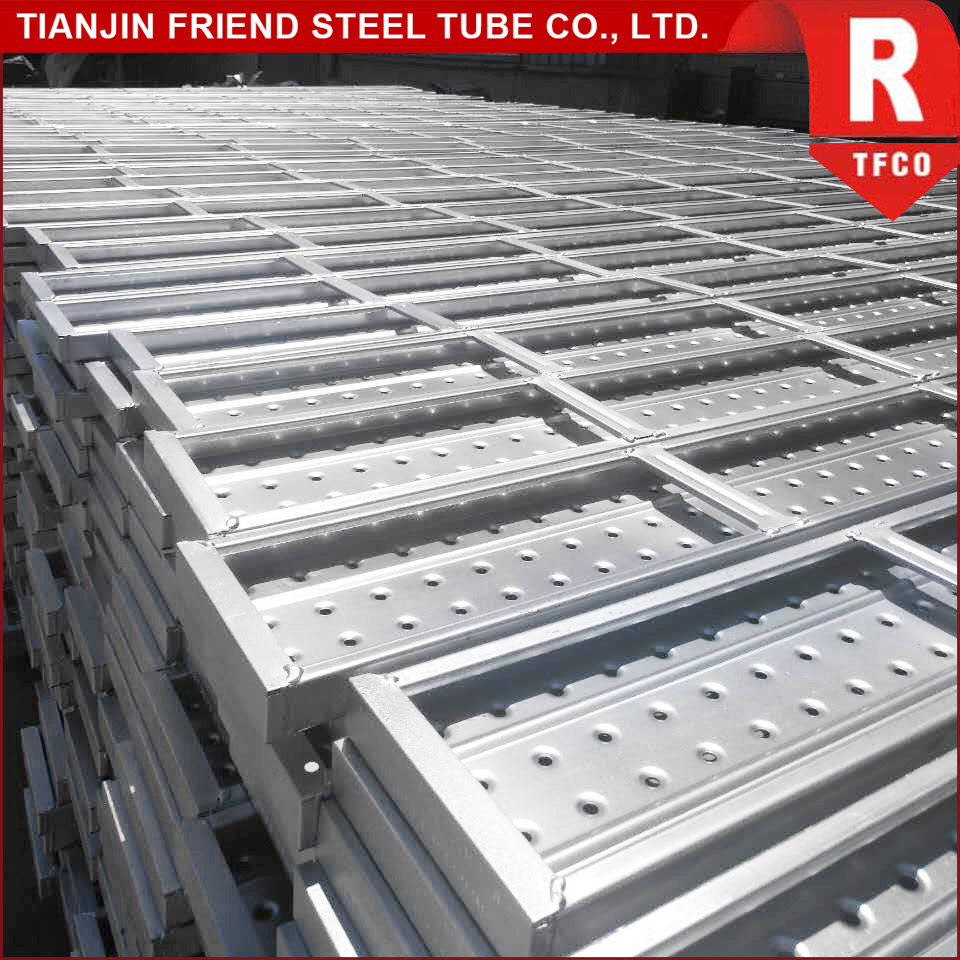
A traditional setup relies heavily on standard drop-in decking. Workers lay boards across the horizontal support bars. Access typically requires a dedicated Frame Catwalk to move between structural bays safely. Sometimes teams use standard aluminum-plywood decks to save weight. Contractors frequently utilize a standardized Scaffold Steel Board to handle heavy masonry materials. Alternatively, they might span the open gaps using a basic GI Scaffold Plank. These individual components create a rigid working platform rather quickly. However, they simply rest on the frame structure. They do not structurally lock the entire bay together. They merely provide a walking surface.
Ringlock utilizes advanced interlocking steel planks. These rugged planks lock directly into the horizontal ledgers. This specific action adds crucial horizontal rigidity to the entire structure. The deck becomes an active structural component. The design minimizes dangerous tripping hazards. It offers seamless flush-decking capabilities across massive areas. You also benefit from integrated toe-boards. Safety inspectors strongly prefer this flush finish. Workers can push heavy tool carts across the steel deck without hitting uneven bumps. The entire platform acts like a solid, continuous commercial floor.
Time is money on a demanding job site. Erection speed heavily dictates project profitability. We must compare practical, real-world deployment scenarios to understand labor efficiency.
Imagine perfectly flat terrain against a straight masonry wall. A standard Galvanized Scaffold Frame generally goes up much faster here. This method requires handling fewer individual components. You simply stack the rigid units. You insert the cross braces and drop the walking boards. A small team can cover a massive linear facade rapidly. The inherent simplicity drives incredible daily progress.
Complex terrain changes the mathematical formula completely. Ringlock drastically outperforms traditional models here. Uneven ground presents major hurdles for rigid frame legs. Circular tanks and architectural protrusions slow down traditional builds. Teams waste time building clumsy tube-and-clamp workarounds. Ringlock rosettes solve this problem instantly. They allow quick, geometric adaptations. You can change ledger angles on the fly. You navigate difficult slopes using varied standard heights.
We must also discuss labor skill requirements. Traditional frames require less specialized training. Basic assembly remains highly intuitive for entry-level workers. They learn the stacking process in hours. In contrast, Ringlock demands slightly higher initial competence. Crews need a firm understanding of ledger math and diagonal bracing formulas. They must visualize the geometric grid before building. However, the system eliminates traditional guesswork. The wedge pins lock at fixed, engineered angles. Once trained, crews accelerate complex builds significantly.
We must evaluate your initial financial layouts carefully. Equipment longevity also plays a vital role in procurement strategy. We will focus strictly on CapEx and physical toughness here.
Traditional setups present a significantly lower barrier to entry. They typically require 20% to 30% less initial capital expenditure. This holds true when comparing identical square footage metrics. Smaller contractors often prefer this reduced upfront financial burden. It frees up critical cash flow for other materials.
Physical durability reveals a different story. Welded legs take severe abuse on active sites. A hot-dipped Frame Scaffold System resists rust and environmental corrosion beautifully. However, vertical legs remain highly susceptible to bending forces. Transit drops or rough yard handling cause irreversible damage. Once a structural leg bends, the entire welded unit becomes compromised. You must discard the bulky piece.
Ringlock components differ dramatically in resilience. Individual ledgers and standards offer inherent impact resistance. They are solid, single-axis steel tubes. They lack fragile welded joints stretching along their length. You replace them cheaply on a strict per-component basis. If a forklift bends a ledger, you only replace that single pipe.
Yard space logistics also matter immensely. Ringlock parts pack incredibly dense. They stack tightly on flatbed delivery trucks. Welded frames require significantly more cubic volume. They consume massive space in staging areas. Shipping empty air costs contractors real money every month.
Structural failures lead to catastrophic site consequences. We must view equipment procurement through a strict compliance lens. Wind shear and human error pose the biggest threats.
High wind loads stress temporary structures laterally. Ringlock provides superior rigidity under these extreme environmental forces. The heavy-duty wedge-lock mechanism resists twisting motions effectively. It locks the rosettes tightly into place. This prevents the working bays from swaying excessively at high altitudes.
Human error introduces another major vulnerability. Traditional systems face unique daily risks. Crews sometimes forget to install crucial cross-braces. They might lose small toggle pins in the mud. Missing pins severely degrade total vertical load capacity. The frame becomes unstable under heavy masonry pallets.
Ringlock’s rosette design actively prevents this negligence. It forces a geometric, visibly locked-in assembly. The hammered wedge pins remain highly visible from the ground level. Safety inspectors can audit the nodes quickly from a distance. If a wedge remains loose, it stands out clearly to safety managers.
You must always assess local OSHA or EN compliance guidelines. Authorities mandate specific load classifications for different trades. Light-duty ratings allow 25 pounds per square foot. Heavy-duty tasks require 75 pounds per square foot to support concrete blocks. Ringlock often scales to these heavy-duty industrial ratings effortlessly. Traditional frames usually max out at medium-duty capacities depending strictly on the tube gauge wall thickness. Always verify your manufacturer payload data.
You need a clear framework for equipment procurement. Use the following criteria to guide your upcoming capital purchase. Match the system directly to your specific daily operations.
Choose a standard frame setup if your projects align with these realities:
Your projects involve predominantly straight, flat building facades.
You primarily build standard residential properties or commercial masonry walls.
Strict budget constraints demand significantly lower initial procurement costs.
Your staging yards have ample space to store bulky, welded units.
Your temporary labor force possesses minimal specialized scaffolding training.
Choose modular Ringlock systems if your projects match these demands:
The job requires heavy industrial load-bearing capacities for heavy equipment.
You need complex suspended configurations or large birdcage layouts indoors.
The architectural shapes are circular, highly irregular, or feature frequent protrusions.
Your site engineers require frequent vertical bypasses to avoid structural pipework.
Regional labor costs remain extremely high, making rapid assembly speed crucial for profitability.
The choice between a traditional stacked frame and a modular Ringlock platform demands careful thought. It is never about finding a universally superior product. Instead, it is about matching equipment behavior to your operational reality. You must weigh site geometry against available capital. Rigid systems excel on flat, simple masonry walls. Modular nodes dominate complex industrial environments.
Take immediate action to improve your fleet. Conduct a comprehensive yard audit of your existing inventory. Calculate your average labor rates per erection-hour for your specific region. Request official payload capacity charts from your chosen manufacturer. Assess your flatbed transport logistics accurately. Taking these steps ensures a smarter, risk-adjusted equipment purchase.
A: No. They use fundamentally different load-bearing mechanics and connection points. Mixing systems violates manufacturer warranties and strict safety compliance standards. You compromise structural integrity and assume massive liability risks.
A: It depends entirely on the plank's hook design. While a generic steel board might span a frame system easily, Ringlock ledgers typically require planks featuring specific O-hooks or U-hooks designed exclusively for tubular ledgers.
A: Generally, Ringlock systems can be engineered for heavier, industrial-grade loads (Class 4-6). The rigid rosette node connections distribute weight efficiently. Frame scaffolds are typically suited for light to medium duty (Class 2-4) depending on the actual tube gauge.
